

INDUCTION YEAR: 2025
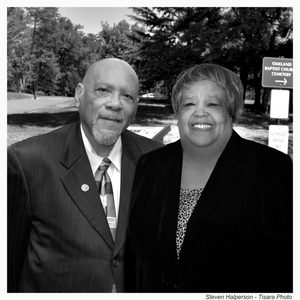
Adrienne Terrell Washington’s calling was clear from the moment she was born. Her mother, Gwendolyn Wilhelmina Terrell, delivered her in 1950 at Freedmen’s Hospital in Washington, DC, instead of Alexandria Hospital, which had limited accommodations for African Americans. As a child, she grew up in the historic neighborhoods of Fort Ward and Seminary Communities, surrounded by her parents, grandparents, siblings, and extended family—where she often heard stories of her family’s presence in the community during the Civil War. She earned a degree in journalism and prepared for her career. She worked for several newspapers and television stations, including The Washington Times and the NBC news station. Throughout her career, she held leadership roles as a Deputy Metro Editor, District Bureau Chief, and Columnist, earning multiple awards. Washington is the mother of two adult children, Mario and Misti Washington.
In 2009, Washington and several others received an email from Dave Cavanagh requesting, “We need your help in protecting the African American experience at Fort Ward.” This call to action sparked the organization of the Seminary and the Fort Ward African American community. Washington started recruiting and organizing people in her community and beyond. The group named itself the Fort Ward and Seminary African American Descendants Society. The Society elected Adrienne Terrell Washington and J. Glenn Eugster as its co-presidents.
The mission of the Descendents Society is to “describe, interpret, protect and celebrate the living legacy of African Americans who contributed to the defenses of Washington, D.C. at Fort Ward in an effort to win their own freedom which has led to a more perfect Union.”
After the Civil War, a neighborhood known as The Fort grew up around Fort Ward, one of the Union forts built as part of the Defenses of Washington. But in the 1950s and 1960s, the City moved the residents out of the area to establish the Fort Ward Park and Museum.
The primary goal of the organization is to share the history of African Americans in order to describe the role they played and the contributions they made during the Civil War at Fort Ward and in helping to create the Seminary community. African Americans were crucial to the war effort; and that the war is best understood not just as a military phenomenon, but as a social and political one as well.
To achieve success in creating significant positive changes at Fort Ward, the group focuses on its members’ expertise. Washington, a descendant with strong leadership abilities, played a key role in organizing the Society, engaging all descendants, collaborating with the City of Alexandria, securing media coverage, and serving as the Society’s voice and face. She helped write Fort Ward’s brochure and contributed information and pictures for a publication titled “Finding The Fort: A History of an African American Neighborhood by Dr. Krystyn R. Moon, June 2014.”
Eugster, the co-president of the Society, retired from the federal government at the National Park Service in the National Capital Region. His expertise was in helping communities and park managers revive economies and ecosystems. Eugster’s contributions to the Society included working with the City of Alexandria and engaging City Council members about Fort Ward. He was an authority on Fort Ward and managed several websites related to the Fort and the Seminary.
Together, Washington and Eugster built their board with help from other descendants who shared their expertise: David Cavanagh, who lived near the Seminary area, helped establish the Society’s legal status through the bylaws and articles of incorporation; Brenda Adams, a descendant of the Seminary and Fort Ward, provided important research and information about the Fort; and Alfonzo Terrell, a descendant, volunteered his time to work with the City Archaeologist to identify community graves.
Washington enlisted Gerald Amos Wanzer, a descendant of Fort Ward and Seminary, to create and manage a Society Facebook page that documents the Society’s achievements and provides photographic history. He has been running the Society’s Facebook for over a decade. As a descendant, his family has lived in the Fort Ward and Seminary area since the Civil War. Wanzer is the father of four adult children: Craig I. Wanzer, Edward Brown, Jessica Wanzer, and a deceased son named Aaron G. Wanzer.
With help from Washington, Eugster, and Wanzer, they encouraged community elders to share their histories with city officials. Most of those elders are no longer alive, but their stories are preserved thanks to the hard work of this society.
Before the Society’s involvement, parts of Fort Ward were used as a dumping ground, and the descendants’ family gravesite was deteriorating due to heavy rains and falling trees. The Society focused on restoring the gravesite and working with the City to improve the conditions of the Fort.
Today, the African Americans whose families once lived in Fort Ward are acknowledged and documented. The Fort’s appearance has improved since the Society’s involvement, and the graves are in better condition than before.
By Char McCargo Bah
Photo Credit: Steven Halperson/Tisara Photo