

INDUCTION YEAR: 2024
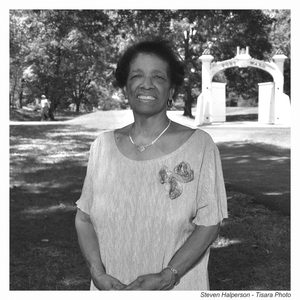
Francis Terrell is living legend with long, deep roots anchoring her to the Alexandria Seminary community. She stands out among all citizens for her efforts: to preserve Alexandria’s historic African American communities; her extended volunteerism in service to both her faith and residential communities; the respect shown for the hard work of her ancestors to thrive here against long odds; and her enduring community spirit.
Just as her ancestors were integral to the founding of “The Fort” and its surrounding communities, Terrell has been integral, a driving force, in the preservation and remembrance of their work and contributions. Today that history of African American families’ exploration of their new life freedoms in Alexandria after the Civil War is known, not lost to history. For more than a decade, Terrell has engaged in assuring that the past is not only acknowledged, but also memorialized for the important contribution it represents for descendant families and for Alexandria’s history. Terrell’s personal efforts have made a lasting difference in how the city now acknowledges and memorializes African-American contributions to its past.
Born Frances Colbert Clements, in 1943, Terrell grew up in in the Seminary area, of what was still a highly segregated Alexandria city. Her mother, Mary Agnes Johnson, was the great granddaughter of Wallace Wanzer, who settled there before the Civil War. In 1986 Francis married Calvin Terrell, whose family also has strong connections to the area. Calvin’s mother, Beatrice, was a teacher at the segregated one-room school and at the new Seminary School around the turn of the century. Francis and Calvin’s extended families lived in homes on Braddock and Seminary Roads, King Street, and Quaker Lane. Many of their family members still reside in the Seminary area. Her cousin lives in the house that was home to her grandfather; the man who helped build the Oakland Baptist Church on King Street in 1892. Her parents, later, both served as Deacons there.
Terrell followed her parents’ example, being deeply involved with her church and becoming a Deaconess at Oakland Baptist herself in 1996. She serves in the position today, saying, “It’s all about God. We help the community: the people and families in the church, taking care of everyone.” That includes organizing gifts of supplies each new school year to assure students have all they need.
Taking care of their own, and a focus on education, is a spirit her Fort Ward ancestors knew well. In 1865, as the Civil War ended, African Americans had gained their freedom but were faced with the problem of where to live and how to survive. By 1879, they began to buy property for homes, to farm, or for businesses, on the land abandoned as a military base, where they had served as troops, laborers, cooks, and drivers. Their “Fort” community was often overlooked by the larger city for services and education. The founding families recognized the need to establish schools and churches, to care for their own. Many donated land, money, and other resources to meet the needs of all.
Terrell pushed for and served on the city’s advisory committee, formed in 2009, to review the management of Fort Ward Park. She and other city residents had become deeply concerned that the rich history of the Fort’s founding families was being ignored; destroyed after the city claimed land there to create Fort Ward Park. While the city focused on the park’s history of Civil War Union encampment there, no public recognition was being given to its nearly 100 years of African American history. Terrell sought to bring attention to their contributions, their church, school, and gravesites.
Terrell was an active citizen member of the city’s Fort Ward Park advisory committee for the three years of their work. She wrote the chapter on the history and culture of the Fort community for the report issued in 2011, which brought to light information unknown to most Alexandrians.
Going beyond bringing the lost history to light, Terrell, as a founding member, helped organize the Fort Ward and Seminary African American Descendants Society in 2010. The Society worked with the city’s archaeology department to identify unmarked properties and graves. As a result, the city recognized “significant parts of Fort Ward Park are hallowed ground.”
In 2015 the city council officially adopted the Fort Ward Park and Museum Area Management Plan, to provide a strategic long-range plan for the historic area and park site. In acknowledging the input of stakeholder groups, which included the Descendants Society, the plan included the goal “to protect and maintain the nationally significant historic and cultural resources and locally significant natural resources found within Fort Ward Park.”
Terrell’s individual contribution to discussions about the work and plan have been acknowledged as “influential” in making a difference in how the city responded positively to telling this black history part of its past. Her friend and colleague, Carter Flemming, said, “Her story is an inspiration that shows others how a determined individual can make a difference in correcting the narrative of forgotten history.”
As a member of the Descendants Society, Terrell represented the group in symposiums and in annual commemorations to share and highlight the history, and describe the role played by ancestors of the Cravens, Randalls, Wanzers, Terrells, Caseys, Belks, Adams, Halls, Ashbys, Woods, Jacksons, Johnsons, Shorts, Simms, Colberts, Brooks, Bradbys, Henrys, Lewis, and others.
The work of the Descendants Society also attracted the attention of archaeologists and scholars, resulting in a number of books and articles detailing the history of the Fort community. Notably, Dr. Krystyn Moon wrote, “Finding the Fort: A History of an African American Neighborhood in Northern Virginia, 1860s-1960s.” This interest and research are a direct result of the work of the Descendants Group to ensure that the story of this almost-forgotten community is remembered and told.
Terrell remains an active member of the Seminary Civic Association; having served as president for 10 years, from 2011 to 2021. Since 2019, she has served on the board of the Seminary Hill Association, addressing a variety of resident issues from traffic congestion to environmental threats; engendering a philosophy of respect and inclusiveness for all.
As a matter of furthering respect, she advocated successfully to change the reference to the historic area shown as “Mudtown” in city land records. The derogatory name was used during the Jim Crow era when the African American area was denied the paved streets of the communities surrounding it.
In appreciation of her efforts, the City of Alexandria issued a proclamation on Terrell’s 80th birthday honoring her numerous contributions. Visitors who go to Fort Ward Park can follow the Fort’s Heritage Trail, created to identify the historical landowners and their stories. Descendant families are grateful for the preservation of the dignity and integrity of their loved ones buried there. And now the city recognizes Terrell as an Alexandria Living Legend.
By: Susan Maume
Photo Credit: Steven Halperson-Tisara Photo