

Induction Year: 2025
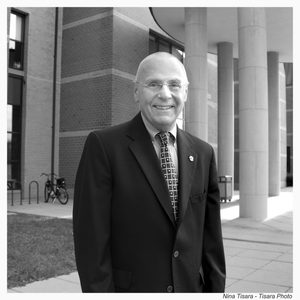
In the 1990s, libraries faced a new and existential challenge — the development of revolutionary digital computer technology. During that period, household ownership of computers doubled, bringing information to one’s fingertips at many homes, seemingly with less need to travel to local libraries. Given libraries’ ancient beginnings in the Fertile Crescent about 2500 BCE, and their on-going changes over centuries, one might be forgiven for comparing the ’90s struggle of libraries to adapt to the computer internet age to Sisyphus’ labors with the boulder on the hill.
It was just at that time, in 1992, that Patrick O’Brien came to Alexandria’s Library system as the new director. Born on St. Patrick’s Day in Newport, Rhode Island, O’Brien had moved around the country to create a career as a librarian, working in several large libraries, including Chicago and Dallas. He accepted the Alexandria job in 1992 after the oil bust in Texas saw funding for libraries there shrinking. He relates, although coming to a much smaller system in Alexandria, he was pleased to find a “welcoming community with total support of library services”.
That support included plans, underway when O’Brien arrived, to expand the Queen Street central library to nearly double its size. Under his experienced eye, the existing plan received new scrutiny. Noting missing design elements, he championed use of a professional community needs assessment to review the expansion plans. That review led to a decision to instead build the larger Charles E. Beatley Jr. Library on Duke Street. The new design included a community meeting room, parking and other amenities beyond the original plan for expansion of stack space. It opened in 2000, becoming the new central library. At the time it opened, its new building design and layout, with input from O’Brien, provided an example of how a modern, well-designed building facility could help connect the Alexandria Library to the many diverse needs of its community members.
During the period of O’Brien’s directorship, the city’s other library branches, the Kate Waller Barrett and the Ellen Coolidge Burke Branches, built in 1937 and 1968 respectively, also came under revision under his supervision. In a checkerboard collection of growth and moves, the system saw Beatley house the central collection in its new location; Barrett added space for the city’s historic and genealogical research collections; and Burke closed, with its collection moved to Barrett, then reopened again with a smaller presence. All these major moves, which might have again ignited thoughts of Sisyphus, O’Brien accomplished, calling it all, “A matter of good planning to move the collections and reorient the staffs.”
When O’Brien arrived in Alexandria, not only did he come to a city in the midst of growing library service needs, he arrived as the city was poised to make decisions about public internet access. Part of his modernization of library services included providing for access to digital services. He sought out seats on the two boards tasked with incorporating the city’s technology plans: the Cable Television Commission and the Task Force on Information Technology. As he describes, “hitting it off” with the cable company provider president, and recognizing the CEO’s passion for the new technology, O’Brien was able to secure the donation of two internet capable computers for the Ellen Coolidge Burke Branch to test public library high speed World Wide Web access.
Web access was the first step in bringing information technology to the library, the first area library to do so. O’Brien also designed the library’s first web site. It became the first for an Alexandria city department. As information technology systems expanded, O’Brien oversaw the introduction of the first 24/7 remote access to library resources for library patrons. Today many library services are accessed online by patrons, including by those without internet service in their homes. It allowed students to expand their knowledge, complete homework and assure all students had the same internet access regardless of whether there was access to a home computer. The library service also provided adults without home internet service or computers the anility to connect for increasingly necessary computer functions and tasks; as diverse as completing job applications, paying bills, or just enjoying entertainment. The current cable provider continues to provide free internet service to city libraries, which O’Brien first championed, for an annual savings of about $35,000.
Even with generous city support, Alexandria’s budget experienced periods when the library was asked to reduce expenditures. In such a period, O’Brien found a way to supplement city funding for the library system by establishing private foundations: the Alexandria Library Foundation and the James M. Duncan Foundation. The initial foundation established a goal of $50,000 in private donations. Achieving that goal in the first year, it continued to raise money even as the city budget situation improved. The money was used to increase popular e-books access, children’s story-time programs, and adult classes and programs. The Duncan foundation concentrated on plans to expand the Del Ray branch with a green “living” roof in order to reduce stormwater runoff and pollution to local waterways. Completed in 2005, it became the city’s first government building to adopt this conservation strategy.
Both during his working career and following his retirement in 2008, O’Brien engaged in service to the community beyond his library innovations. As a member of the Alexandria Rotary Club, he served as club president; was named 2001 Rotarian of the Year; and received the Rotary International Avenues of Service Award in 2016. A volunteer with both Senior Services of Alexandria’s ALIVE! food distribution program, and with Alexandria Meals on Wheels for several years, he and his wife were named Meals on Wheels Volunteers of the Year in 2016.
These days, O’Brien, a passionate and skilled woodworking artist, helps raise funds for Alexandria student scholarships by donating art pieces for silent auctions and events. He is an art contributor to the annual Taste for Giving event sponsored by the Alexandria Rotary Club to support local nonprofit organizations.
As O’Brien shares, “My goal was always to elevate the public library to the most used of all public services of the city of Alexandria. That goal was achieved by the time I retired, and it has been expanded to even greater use by my successor. The Alexandria Library had over 1.5 million visitors and web users last year. The public library serves kids before schools get them and provides all users with services by professionals, without appointment or question, or regard to their means or station in life.”
It seems that includes the professional services of Living Legend Patrick O’Brien, who continues to successfully achieve his aim to serve the Alexandria community.
Credit: Susan Maume
Photo Credit: Nina Tisara